


This post is a BiblePoetry guest post collaboration from Aaron Sun, who is a seminary student at Westminster Theological Seminary. He writes on Substack and posts his writing, poetry, and illustration there.
This is Part 1 of a series on the techniques and theories that make Poetry so impactful and beautiful! When Toby, the founder of BiblePoetry and I first met we were amazed at my ability to understand Hebrew Biblical poetry concepts. We realized that this came from my ability to understand literary techniques from the English. Reading poetry isn’t confined to just English, but the techniques are found in all of life, transcending language.
The Sela app from BiblePoetry aims to make Biblical Hebrew more accessible without knowing Hebrew fluently. It does this by preserving word order and count so that these poetic devices are more easily spotted.

Intro to Poetry & its Importance
When C.S. Lewis tackled the question in his paper to The Oxford Socratic Club, Is Theology Poetry?, he answered with a resounding...“No!”1 Umm, well, that’s one way to start this series. But 1/3 of the entire Bible is poetry, so surely, it’s important! The fact that Lewis had an essay dedicated to the topic implies that there is merit to reading the Bible as Poetry.
Like “incarnation”, form cannot be separated from function. HOW DOES THIS READ?—Quite loud, right? Try listening to a podcast whose host is monotonous, uninterested, and labored, it’s not going to be very exciting. Great oration matters in speech. Equivalently, great prose is integral and essential to delivering ideas. This applies to graphic design also, think back to the all-caps, or of the times you’ve struggled to read a paragraph because it was spaced poorly or justified.
Therefore, structure and form drive the delivery of content. And without understanding the incarnated form, the content is not fully appreciated. One could even argue that it can’t be understood at all if the form is itself a type of language one has to learn.
For more on why we should learn poetry refer to this post by Before All Things “God Wants Us to Know Poetry.” The post cites Leland Ryken, Wheaton English professor emeritus,
The books of Ecclesiastes and Revelation, though printed mainly as prose, are actually poetic in their technique. Jesus’s discourses are heavily poetic in their language, and it is no stretch to say that Jesus is one of the world’s most famous poets. Beyond these saturated poetic parts of the Bible, we find metaphors and other figures of speech on nearly every page of the Bible.2

The Power of Comparison (Simile and Metaphor)
The Christian and human experience is an experience of knowing, or as philosophers would term, “epistemology.” How do I know that God loves me? How do I know that my spouse loves me? How do I know if I am sinful, or good? How do I know the truth? Humans know by association. This is the way that God has designed us, we were made for community and communion with all around us, and this includes the act of “knowing” itself.
Professor and theologian Kelly Kapic writes in You’re only Human, that a sociology exercise developed for students is to introduce themselves without referencing groups they hold memberships to. Alas, it is an exercise in futility and nearly impossible. One might say, “I like playing soccer on Saturdays” but that’s a team sport and implies the involvement of other people.3 Descriptions of “I am a son, or I have a sister” implies the membership of family. Maybe you’re a runner. Finally, a solo activity. But, “where do you run?” The streets of New York. Oh, then you’re an American.
As humans, we may desire to know things in isolation. But this perhaps is the Fall of Eden. Danish philosopher Søren Kierkegaard defines sin as the desire for man to be self-referential. Kapic contrasts the Biblical communal and relational epistemology with the modern existential motto of Sartre that “Man is nothing other than what he makes himself.” So, original sin is a sickness that speaks thus, “I want to make the rules. I want to live apart from God. I want to define myself.”4 But God says otherwise, to truly know something is actually to know more things in relation to the subject.
More can be said about this, but you’ll have to wait for Part 2!

Examples of comparison in helping us know
Simile, is making a comparison to something using “like” or “as.” Metaphor makes these same comparisons without using “like” or “as.”
Let’s look at the first two lines of Shakespeare’s “Sonnet 18”
Shall I compare thee to a summer’s day?
Thou art more lovely and more temperate.5
Shakespeare here is metaphorically comparing and contrasting his lover to a summer’s day. He follows the Elizabethan era’s obsession in trying to describe perfect love. The Bard uses descriptions in saying that his romantic interest is better than all summer weather. The experience of summer is not even comparable to being with his lover. He knows what summer is like, so therefore, he can say he prefers his lover.
Or this famous C.S. Lewis quote,
“I believe in Christianity as I believe that the Sun has risen not only because I see it but because by it I see everything else.”6
To Lewis, knowledge of God in isolation is nonsensical. He knows God because he has seen the world itself and experienced it. He has experienced Joy in the world and therefore he knows that God must have provided that experience. Similarly, he has experienced Love, and knows what God is: Love. Knowledge of God here is equated to seeing the world (the sun), and likewise by its illumination Lewis sees everything. The statement is not “I believe in Christianity”, full stop. It is I believe “as”, and “like.”
This seems circular in some sense. But it’s God’s way of requiring connection and it doesn’t make things untrue. If we want to get mathematical about it, one can reference Gödel’s incompleteness theorem.7 The theorem’s hypothesis is that explanations and proofs of things must reference other premises, notions, and proofs of other things.
Biblically, Jesus does this all the time when teaching. And so follows the entire framework of epistemology. Knowing is structured into “if this-then that”, if “the premise is true, the conclusion follows.” And so, Christ explains “your earthly fathers display such love” and therefore, “how much more would your heavenly Father display greater love” (Lk 11:11).

An Example in Biblical Poetry: Psalm 133
Now on to the first example. What insightful truth does simile convey in Psalm 133?
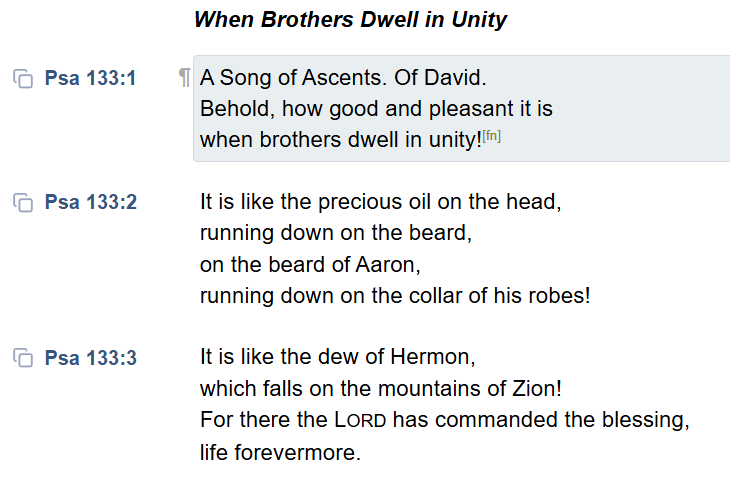
Psalm 133 is structured as a chiasm. Meaning that the poem is structured like a mountain, an ABA format. Therefore, idea A in the start of the poem mirrors that of idea A at the end. And idea B is the climax where idea A culminates.

This mountain structure is emphasized in Psalm 133 for two reasons. First, as it is a “Song of Ascent”, it would be sung by worshippers as they travelled to Jerusalem to worship and offer sacrifices. Second, because the poem has a description of the “mountains of Zion” (v3).
We then observe that the Psalm makes multiple comparisons and equivalences with its similes.
V1-2:
(A) Brothers who dwell in unity (is like)
(B) the oil on the head of Aaron,
V2-3:
(B) Oil on the head of Aaron (is like)
(A) the dew on the mountain commanding blessing of life forevermore.

Per the chiastic structure, it follows that there is some equivalence where A=A. Therefore, the “brothers who dwell in unity” is equivalent to the “blessing of life forevermore.”
Insight #1: There can be no isolated Christian. That is an oxymoron, an isolated Christian is in some deep danger here. Christians are called to dwell in unity and have togetherness. It’s in this unity where the blessing of everlasting life is.
The simile structure doesn’t end there, in the chiasm B is also made equivalent to A. The chiasm also calls attention to B as the climax and mountaintop of the Psalm, so out of B, all things flow.

Insight #2: Aaron is the mediator to the Israelites, the high priest who commands the blessing. He is the “head” of the body which all things come out of. Dwelling in unity of the body is the experience of dwelling with Christ as the head who mediates the blessing.
To be in Christ, is to be adopted into a family of unity, and is to have the blessing of life forevermore.


An Example in New Testament Greek and Theology
Lastly, we can observe the same words of “like” in the Greek New Testament. The words “ὡς” (hos) and homoioi (ὅμοιοι) are translated to “as it were/like” and “like/similar to.”8 Theologically, this is important because we observe these comparisons and similes also in the NT.
First note, the Greek Septuagint (LXX), which is the Hebrew Bible translated to Greek, used even by Jesus and the disciples—translates the brothers in unity as “ὡς” (hos) for the “like” statements in Psalm 133.9
We can see this same verbiage in many NT texts. Let’s highlight the one below.
“Beloved, now we are children of God; and it has not yet been revealed what we shall be, but we know that when He is revealed, we shall be like (ὅμοιοι, homoioi) Him, for we shall see Him as He is.” (1Jhn 3:2) 10
It’s with this reason that Luther confidently makes the statement that we are “masks of God”11, and as Paul described the “body of Christ” (1Cor 12:27). When the world sees us Christians dwelling in unity, having life, and a priesthood which commands the blessing of life—then it sees something which is like Christ. Allowing the world to better know Christ.
So, the statement of Lewis can be reworded when these displays of the likeness of Christ in the body (the church) are shown, “I believe in Christianity, as I believe the love of Christians and have experienced it.”
Insight #3: We are Christ to the world, showing the world what Christ is like in unity, submission to the head of Christ, and in the outflowing of blessing. How can we mediate the blessing of Christ to our church body and to others in the world?
Conclusion
This wraps up Part 1 of the series exploring English literary and poetic devices and their similarities to Biblical Hebrew Poetry. We believe God’s Word is a masterpiece which is worth devoting our lives to studying. Poetry is also a language, one which God intends to use to reveal truth, and as language is learned the Beauty of it springs out.
Follow along for Part 2!
Refer to essay “Is Theology Poetry?” Staples Lewis, Clive. Essay Collection. HarperCollins Publishers, 2002. Lewis distinguishes between a truth claim vs an aesthetic experience. One would say that as a human to know something is also to experience it. In this way, Poetry really does give us something of the truth as an experience.
“Learning the Lyrics of God,” Desiring God Ministries, May 14th, 2020.
Kapic, Kelly M. You’re Only Human : How Your Limits Reflect God’s Design and Why That’s Good News. Brazos Press, 2022. Refer to Chapter 5 “Is Identity Purely Self-Generated”
Refer to The Sickness unto Death. Where Kierkegaard writes that sin is “despair”, where “despair …severing the self from any relation to a power that has established it, or severing it from the idea that there is such a power.”
Ibid. 1 Refer to essay “Is Theology Poetry?” Staples Lewis, Clive. Essay Collection. HarperCollins Publishers, 2002.
Wolchover, Natalie. “What Do Gödel’s Incompleteness Theorems Truly Mean? | Quanta Magazine.” Quanta Magazine, 18 May 2026, https://www.quantamagazine.org/what-do-godels-incompleteness-theorems-truly-mean-20260518/.
On axioms, “Intuitions have always played an important role in mathematics. After all, we can’t prove everything; we need to accept some truths (i.e., the axioms) without proof in order to get our proofs off the ground.”
Refer tohttps://www.blueletterbible.org/lexicon/g5613/nlt/tr/59-1/ and https://www.blueletterbible.org/lexicon/g5613/nlt/tr/59-1/ . Also refer to Albert Barnes’s commentary on Revelation, where he states, “And on their heads were as it were crowns like gold - The writer does not say either that these were literally crowns, or that they were actually made of gold. They were "as it were" (ὡς hōs) "crowns," and they were like (ὅμοιοι homoioi) "gold." That is, as seen by him, they had a resemblance to crowns or diadems, and they also resembled gold in their color and brilliancy.” https://biblehub.com/commentaries/barnes/revelation/9.htm
Refer to https://www.blueletterbible.org/sample/lxx/psa/133/1/ If translating the brothers in unity chapter as “as it were” (ὡς hōs) instead of “like”, it even seems to make the comparison stronger.
Veith, Gene Edward. “Masks of God | Modern Reformation.” www.Modernreformation.Org, 2 May 2007, https://www.modernreformation.org/resources/articles/masks-of-god.
Wow. Aaron, thank you. You take us from the extremely broad—how do we know?—through the poetic speech of God, which uses comparison, to the Bible’s core message of God’s blessing for humanity, as a large interconnected body. (This message of blessing is seen in God’s precious first words to us, in Genesis 1.) All the while, you’re practically calling us to demonstrate God’s nature by building unity, reminding us how God’s blessing is to be shared liberally with others. “It’s in this unity where the blessing of everlasting life is.” Totally.
I’ve enjoyed our interactions over the past while. I offer these reflections on your thought-provoking post. Please indulge me, as inspiration has hit and it will take time to unpack. :)
On Psalm 133, do you know where the oil on Aaron’s head comes from? Moses, his brother, poured it out! A partner in ministry, who had once betrayed him, leading the nation into apostasy, at the moment God gave his laws to Moses atop the mountain, was not executed—or even removed from office! God physically demonstrated this mercy to Aaron, by having Moses himself anoint his brother as high priest (Lev 8). Talk about mercy!
When Aaron and Moses did everything commanded by the Lord in preparing the tabernacle, they came out—together—from the tabernacle. And they—together—BLESSED the people (Lev 9:23). And then the magnificent happened… the GLORY of the Lord appeared.
Truly letting bygones be bygones—and mutual support of one another’s unique call—led to the blessing of God’s people and the coming-near of God himself! THAT is the oil on Aaron’s head in Psa 133!
Moses was earth’s most humble man (Num 12). He consistently sought the blessing of others, even when personally injured by them. God once offered to remake a new nation through him, but he declined. He would rather see others blessed. He asked for his own name to be removed from God’s book, rather than have the people be destroyed. It is breathtaking! He clearly prefigures the Messiah.
In Psalm 133, Moses gets only a cameo. Not even his hand is mentioned! Only the oil he pours.
How badly do we want God‘s people to be blessed? How greatly do we long for God‘s glory to be manifest in his people? Do we long for God‘s glory and people’s blessing, even when our personal injury is not known and our name receives no mention?